 Aguas Calientes City Guide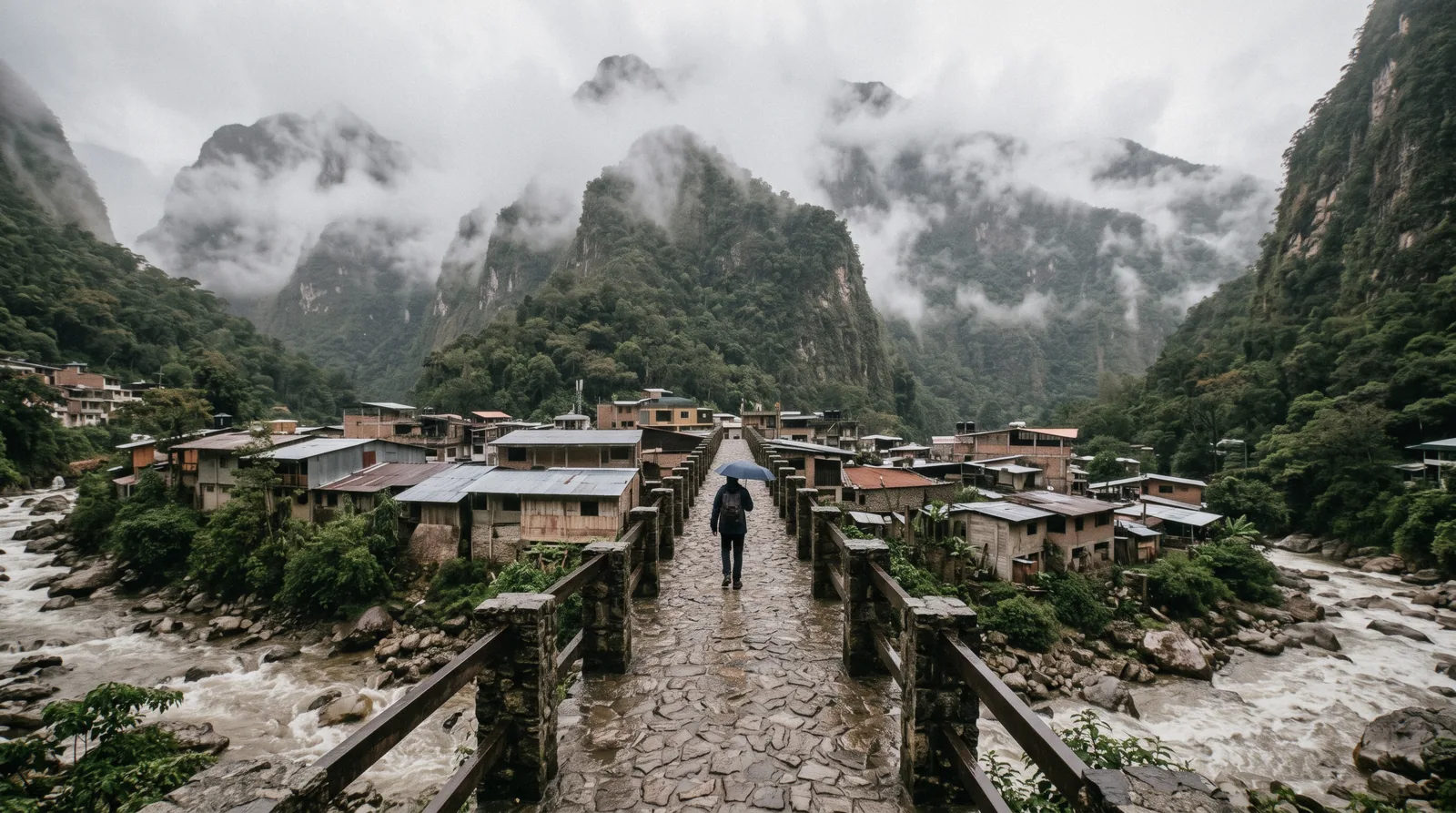
Rain in Aguas Calientes: What Still Works and What to Skip
Rain is a normal part of any visit to Aguas Calientes. The town sits at 2,040 m on the Vilcanota River, squeezed into a steep gorge, and cloud sits in that gorge most afternoons for half the year. This page answers a simple question about a rainy day aguas calientes trip: does it ruin your plans? Short answer, no. Machu Picchu stays open, the museum has a free window, the market has covered stalls, and there is a dry riverside lunch you can book through the Cafe Inkaterra lunch. For the full list of options in town, see things to do in Aguas Calientes, and if you are still arranging entry, read our guide to Machu Picchu tickets before you spend anything.
Quick answer Does rain ruin a day in Aguas Calientes?
No. Rain does not close Machu Picchu, so the main event runs in all weather. The wettest month in town is January, with an average of 296mm of rain across 31 rainy days in the climate data. On a wet day you can still visit the citadel, use the free 12:00-16:00 window at the site museum, browse the covered stalls of the market, soak at the hot springs, or book a long indoor lunch.
Key takeaways
- Machu Picchu does not close for rain. Circuits run in all weather, so if it rains on your ticket date, go anyway.
- The ticket is valid only for the date and time purchased, with no date changes or refunds for weather, which is another reason not to hide indoors.
- The best pure rainy-day backups are the site museum (free 12:00-16:00), the covered market, the hot springs and an indoor sit-down lunch.
- What to skip in the rain: exposed viewpoints, the walk up from town on wet stone, and anything that needs dry grip underfoot.
What Rain Actually Closes
Very little, officially. This surprises people who picture the site shutting its gates in a downpour. Here is exactly what the rules say and what they do not say.
Machu Picchu stays open
The Llaqta de Machupicchu does not close because of rain. Entry is organised into three circuits and ten routes, and those circuits run in all weather. The park closes individual trail and mountain routes only for official safety reasons, not simply because it is raining.
No official rain-closure rule exists. If your entry day dawns wet, the correct move is to put on a rain layer and go, because your ticket gives you no other option anyway. Tickets are valid only for the date and time purchased.
Date changes and name changes are not allowed, and refunds are issued only in force-majeure situations that prevent you from arriving at all. A rainy afternoon in Cusco does not qualify. Remember the conduct rules apply in any weather, including the ban on umbrellas inside the site.
Bring a rain jacket with a hood instead, since umbrellas are on the prohibited-items list and staff can expel violators without refund.
What the rules still enforce when it rains
The site rules apply regardless of weather, and two of them matter more when stone is wet. Hard-soled shoes and heels are banned at all times, and on wet Inca stone that ban stops being a formality and starts being common sense. Wear grip-soled footwear.
The other rules to keep in mind in the rain: no walking sticks, no stabilising mounts, no running, and stay on your assigned circuit. Standard entries give you a maximum of 2 hours 30 minutes inside from your entry slot, so a slow, careful pace in the rain fits comfortably inside the window if you pick a single circuit rather than trying to rush between them.
What really gets affected
Rain does not close things so much as degrade them. Visibility from the viewpoints drops when cloud fills the gorge. The stone steps get slick.
Photos lose contrast. The experience is still real, crowds thin a little, and the terraces take on a different character under mist. But if your one non-negotiable is a clear postcard shot from the upper terrace, a heavy-rain day is the wrong day to expect it.
What Still Works Indoors
The town is small and largely open-air, but there are four honest indoor or sheltered options for a rainy stretch of hours. No official indoor cooking classes, cinemas or similar bookable activities were found for Aguas Calientes, so this is the realistic list.
Museo de Sitio Manuel Chavez Ballon, free from 12:00 to 16:00
The site museum sits at the base of the mountain near Puente Ruinas, on the path between town and the citadel entrance. Entry is free between 12:00 and 16:00, which makes it the single best-value rainy-day stop in the area. It covers the archaeology and context of Machu Picchu, so a wet midday pair naturally with a morning or afternoon citadel slot.
Note that only the free-hours fact is officially confirmed. The standard fee outside that window, and whether it is bundled with the citadel ticket, are not stated in official sources. Plan around the free window and you do not need to care.
The covered market
Aguas Calientes has a market with covered stalls, and it is a reasonable place to pass a shower, snack and shop for textiles and souvenirs under a roof. Be aware of one honest gap: official market hours are not published anywhere. Stalls generally operate around train arrivals, but no municipality source states hours, so treat any timetable you read elsewhere as guesswork.
Go when you are hungry rather than trusting a printed schedule.
A long riverside lunch at Cafe Inkaterra
If you want to buy your way out of the rain entirely, the Cafe Inkaterra lunch is the one bookable indoor food experience in town. LimaTours reserves a table at Cafe Inkaterra, set under a traditional Amazonian palm-thatched roof overlooking the Vilcanota River, with a menu of Andean food mixed with contemporary dishes. It costs US$23.00 for a 2-hour sitting, is rated 4.9 from 8 reviews, and carries a full refund if cancelled at least 24 hours before the start.
The pace suits a post-citadel afternoon when the showers have settled in, not a quick bite between buses. You can read more about it on our where to eat page.
The hot springs, with a caveat
Hot water and rain go together well, and the town is literally named after its thermal baths. Soaking in warm pools while rain hits the surface is one of the better ways to spend a wet hour here. The caveat: official municipal hours and the entry fee are not published on any source we could verify, so we will not print a specific fee as confirmed.
Small third-party figures circulate but none are municipality-confirmed. Take cash, expect a modest charge, and check the gate sign when you arrive. See our hot springs page for what is known.
When Aguas Calientes Is Wettest
The climate data for town comes from ERA5 reanalysis normals for 1995 to 2024. One honest limitation up front: this is a model grid cell of roughly 25km, not a ground station. Aguas Calientes sits in a steep valley and real local rain, especially afternoon convective showers, can differ sharply from the grid average. Read the numbers as a pattern, not a promise.
The rainy season months
December through March are the wettest months, each averaging over 250mm. January is the peak at 296mm across 31 rainy days, closely followed by December at 271mm, February at 266mm and March at 253mm. In practical terms, during those months it can rain on almost any given day, usually as an afternoon downpour rather than an all-day soak.
SERNANP, the park authority, describes the rainy season as November to March and recommends April to October as the drier visiting season, which matches the model data.
The dry season and its catch
July is the driest month at 47mm across 13 rainy days, with June at 53mm and August at 66mm close behind. But note the catch: even in the driest month the data still shows rain on roughly a third of days, defined as 1mm or more of precipitation. There is no month in Aguas Calientes where rain is impossible, which is exactly why a rainy-day plan belongs in your pocket year-round, not just in the wet season.
A rainy day pattern worth knowing
In the wet months the useful rhythm is clear mornings and wet afternoons. Many visitors book the earliest entry slots, and that habit makes sense in the rainy season twice over. You beat both the crowds and the most likely shower window, since afternoon convective rain builds through the day rather than starting at dawn.
If your slot is 13:00 or later in January, pack a proper rain layer and expect to use it, and treat the free 12:00 to 16:00 museum window as a natural place to wait out the heaviest part of a downpour before or after your entry time. Entry slots at 06:00 and 07:00 also tend to sell out first for exactly this reason, so booking early in the wet season buys you both a drier morning and an easier reservation.
What to Skip in the Rain
Rain in a steep gorge changes what is sensible. None of the items below are officially banned because of weather, they are just bad ideas when stone and trail are wet.
Exposed viewpoints and mountain routes in heavy rain
The panoramic upper routes and any mountain climb depend on visibility, and heavy rain removes it. Cloud sitting in the gorge means you can pay for a summit entry and see nothing from the top. The mountain routes also require you to be back by fixed times, and slow, wet conditions cut into that margin.
If the forecast for your slot day is heavy rain, prefer a standard lower circuit where the views matter less and the paths are wider.
The walk up from town on wet stone
The walk from Aguas Calientes up to the citadel entrance takes about 90 minutes over roughly 6km, much of it stone steps. Wet Inca stone is slippery, and the hard-soled-shoes rule means everyone is meant to be in proper footwear anyway. In the rain, take the Consettur bus up instead and save your legs and your ankles.
Note that the official status, hours and exact distance of the foot path via Puente Ruinas are not published in official sources, so do not plan a tight schedule around walking it.
Anything you have not verified hours for
This town runs on informal information. Market hours, hot-spring hours and some trail access are simply not published officially by any municipal or park source we could reach. On a rainy day, when a plan B fails because a gate is shut or a stall is closed, you need a plan C that does not depend on a schedule nobody wrote down.
Keep the museum free window, the covered market and a booked lunch as your three independent fallbacks, each confirmed by its own rule rather than a rumor, and you will never run out of dry options even if two of the three let you down on a given afternoon.
Rainy-Day Options Compared
Every realistic way to spend a wet stretch of hours in Aguas Calientes, side by side. The museum and the booked lunch are the two options where you control the timing most precisely, which matters when a shower has your afternoon cornered.
| Option | Covered | Cost | Timing | Best for |
|---|---|---|---|---|
| Machu Picchu citadel | No, open air | Existing entry ticket | Your booked 2h30m slot | Going anyway, rain or not |
| Museo de Sitio Manuel Chavez Ballon | Yes, indoors | Free 12:00-16:00 | 4-hour free window | Context, shelter, zero cost |
| Covered market | Partly, covered stalls | Free to enter | Hours not published | Snacks and souvenirs |
| Cafe Inkaterra lunch | Yes, palm-thatched roof | US$23.00, 2 hours | Booked reservation | A slow dry sit-down meal |
| Hot springs | Partly, open-air pools | Fee not officially published | Hours not published | Warm soak while it rains |
Figures current for Q3 2026.
Plan the Rest of the Trip
Things to Do in Aguas Calientes
The full list of what the town offers, rain or shine, with links out to each attraction.
Aguas Calientes in 1 Day
A single-day schedule built around entry slots, the bus and the town's short list of stops.
Aguas Calientes in 2 Days
A slower two-day plan that leaves room for a wet afternoon without losing the citadel.
Aguas Calientes Hot Springs
What is actually known about the thermal baths, including the official information gaps.
Aguas Calientes Market
Where the covered stalls are and what to expect, hours caveats included.
Machu Picchu Site Museum
How to use the free 12:00-16:00 window at the Manuel Chavez Ballon museum.
Where to Eat in Aguas Calientes
Restaurant options in town, including the bookable riverside lunch at Cafe Inkaterra.
Machu Picchu Tours from Aguas Calientes
Guided tours and ticket bundles that run rain or shine.
Rain and Weather Questions
Can you go to Machu Picchu if it rains?
Yes. The citadel does not close for rain and its circuits run in all weather. Only official safety reasons close individual trail or mountain routes, not rain by itself. Your ticket is valid only for the date and time bought, with no date changes and no weather refunds, so going on a rainy day is the right call rather than skipping. Just swap umbrellas, which are banned inside the site, for a hooded rain jacket, and wear grip-soled shoes on the wet stone.
Which month is the rainiest in Machu Picchu?
January, per the ERA5 climate normals for the Aguas Calientes area: an average of 296mm of rain across 31 rainy days. December (271mm) and March (253mm) run it close, and February sits at 266mm. Note this comes from a coarse model grid cell of about 25km, not a ground station, so actual local rainfall in the gorge can differ from these averages.
When should you avoid Machu Picchu if you hate rain?
If avoiding rain matters more to you than avoiding crowds, avoid December through March, the four months that each average over 250mm, and lean toward June through August, the driest stretch. July is the driest month at 47mm. Even then, the data still shows rain on about a third of July days, so a rain layer belongs in your bag in any month. This matches SERNANP's own guidance of April to October as the recommended visiting season.
What is there to do in Aguas Calientes when it rains and you have no citadel slot?
Three things work without any ticket: the covered market stalls, the hot springs, and a long lunch. The site museum is free from 12:00 to 16:00 and is the best structured indoor option. For a bookable indoor meal, the Cafe Inkaterra riverside lunch under a palm-thatched roof is the main option in town.
Does the rain ever close the hot springs or the market?
No closure rules for rain are published for either, but official hours are not published at all, so we cannot state schedules or fees with confidence. The hot springs and the covered market both operate informally around visitor flow. Check signs on arrival and keep the museum free window as your backup if either is closed when you show up.
We may earn a commission if you book through one of our links, at no extra cost to you. Full affiliate disclosure