 Aguas Calientes City Guide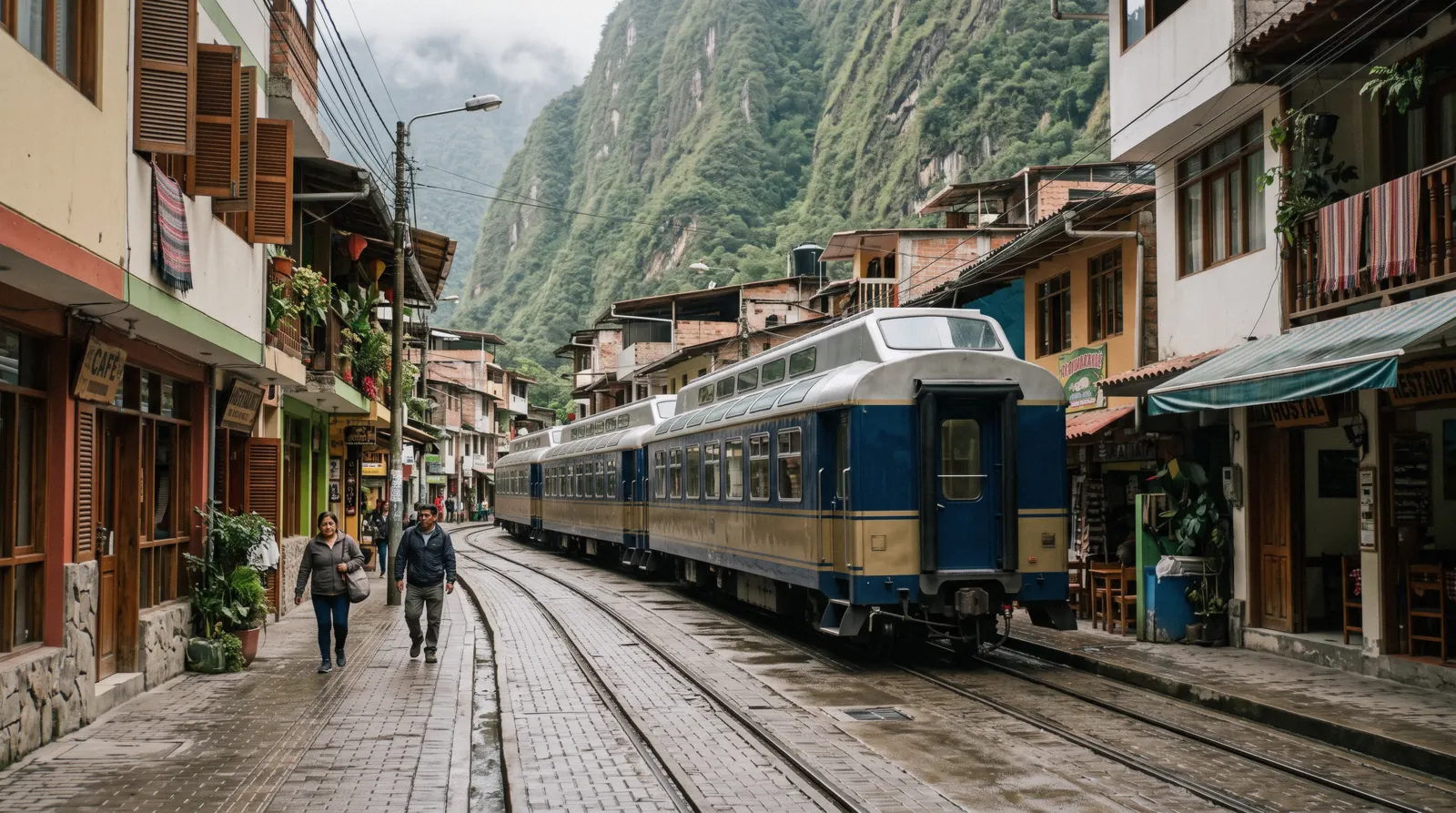
Train to Machu Picchu: Operators, Stations and Fares
The train to Machu Picchu is run by two companies: PeruRail and Inca Rail, both ending at Machu Picchu (Aguas Calientes) station. This page covers how the train to Machu Picchu works overall, which station to use and what to carry. For the two operators in depth, see PeruRail and Inca Rail, and for the luxury option see the Hiram Bingham train.
Quick answer Two operators, stations and what to pack
Two companies run the passenger trains to Machu Picchu: PeruRail and Inca Rail. Both terminate at Machu Picchu Station in the town of Aguas Calientes (Machu Picchu Pueblo), not at the ruins. From the station, a short bus ride or the walking path covers the climb to the citadel entrance. You can start from the Cusco area (San Pedro or Poroy station, or Inca Rail's bimodal bus-and-train option) or from Ollantaytambo, which is closer to the site. One-way fares on Inca Rail start from US$59 (Economy) and vary by date, and a booked train ride such as Trip Tour's train to Machu Picchu costs $130.00 with pickup included. No train ticket includes the Machu Picchu entrance ticket, which is sold separately.
Key takeaways
- Two operators, PeruRail and Inca Rail, both end at the same station in Aguas Calientes town, not at the ruins. See PeruRail or Inca Rail for a head-to-head.
- Depart from the Cusco area (San Pedro, Poroy, or a bimodal bus-plus-train service) or from Ollantaytambo, the shorter hop of about 60 km.
- The Machu Picchu entrance ticket is never part of the train fare, see Machu Picchu tickets.
- Our own train to Machu Picchu card costs US$130.00, lasts 3 hours 30 minutes, and includes pickup. For the rest of the town, see things to do in Aguas Calientes.
How the Train to Machu Picchu Works
There is no road to Machu Picchu. The town at its base, Machu Picchu Pueblo, better known as Aguas Calientes, is reachable only by train or on foot. So for most visitors the trip breaks into three parts: get to a departure station, ride the train to Aguas Calientes, then get from the town up to the citadel gate.
This page covers the whole system at a glance, with deeper detail on the operator pages for PeruRail and Inca Rail and on the luxury option, the Hiram Bingham.
The first thing to understand is what "Machu Picchu station" actually means. Both operators terminate at Machu Picchu Station, which sits in the town itself, beside the Vilcanota River. The ruins are not at the station.
From the platform you either queue for the shuttle bus up the switchback road or take the walking path. We cover that final leg in full on the bus to Machu Picchu and on our Aguas Calientes to Machu Picchu page.
The second thing to understand is that the train never includes entry to the site. The Machu Picchu entrance ticket is managed separately by Peru's Ministry of Culture and sold through the official platform. Read exactly how that works on Machu Picchu tickets, and buy it before or at the same time as your train, because the two are independent and entry slots sell out in busy periods.
SERNANP, the park authority, publishes the official access distances. Cusco to Machu Picchu Pueblo by commercial train is about 111 km and takes about 4 hours 10 minutes. Ollantaytambo to Machu Picchu Pueblo is about 60 km and takes about 2 hours 10 minutes.
Those two numbers explain the whole market: most travellers ride a bus or private transfer from Cusco to Ollantaytambo first, because the shorter rail leg means cheaper fares and more departure choices.
If you would rather book the whole rail leg in one card, our own listing Trip Tour's train to Machu Picchu costs $130.00 for a 3 hours 30 minutes journey with pickup included. Full refund if cancelled at least 24 hours before start, and note availability is limited on this route.
PeruRail and Inca Rail Compared
Two companies run passenger trains on this line. PeruRail is the incumbent and operates from two Cusco-area stations, San Pedro (5 minutes from downtown Cusco) and Poroy (20 minutes from downtown). Its named services for Machu Picchu are Expedition, the lowest-cost option with on-board comforts and decor inspired by Inca culture, Vistadome, with full panoramic windows on the ceiling and sides of the coaches, and Vistadome Observatory, which adds 360-degree views throughout the journey plus onboard live entertainment.
PeruRail also runs a separate long-distance Titicaca train between Cusco and Puno, which is not a Machu Picchu service, and it carries the Belmond-operated Hiram Bingham on its tracks. Full details are on our PeruRail page.
Inca Rail runs two routes: a direct train from Ollantaytambo, and a bimodal service from Cusco that combines a bus through the Sacred Valley with the train onward from Ollantaytambo. Its service tiers are The Voyager (Economy, spacious seating, panoramic windows, ambient Andean music, snacks and drinks for sale, no included meal), The 360 Degree (Premium Economy, open-air observatory car, extra-wide UV-protected panoramic windows, live traditional music, digital entertainment, snacks and drinks included), The Prime (Premium Economy, dedicated dining car, priority boarding, live Andean music, VIP transfer, curated Andean-inspired menu), First Class (fine dining, wine pairings, a bar-lounge car, live saxophone performances, a Wine Ceremony and a three-course gourmet menu), and The Private, a chartered option with limited public detail on Inca Rail's own site. Full details are on our Inca Rail page.
If you are torn between the two companies, our head-to-head page on PeruRail or Inca Rail weighs them up route by route and class by class.
On price, Inca Rail's own booking widget showed live one-way fares on the Ollantaytambo to Machu Picchu route as follows: The Voyager from US$59 to US$85 across departure times, The Prime from US$105 to US$133, and The 360 Degree from US$81. These are date-dependent quotes, not a fixed price list, so treat every figure as a "from" number that shifts with demand. PeruRail does not publish a fixed public fare list in what we fetched, so we cannot quote comparable PeruRail figures here, and its fares are likewise date-dependent.
Our own card, Trip Tour's train to Machu Picchu, sits at $130.00 with pickup included. For context, entry to the citadel itself costs extra and is covered on Machu Picchu tickets.
Figures current in Q3 2026.
Stations and Journey Times
Your first decision is where to board. PeruRail uses two stations in the Cusco area. San Pedro Station, on Calle Cascaparo in Cusco, is 5 minutes from downtown, and its trains to Machu Picchu Station take 4 hours 30 minutes.
Poroy Station, about 20 minutes from downtown Cusco, gets you to Machu Picchu Station in 3 hours 30 minutes. Poroy trains also serve intermediate stops: 1 hour 40 minutes to Ollantaytambo Station and 1 hour 10 minutes to Urubamba Station.
Inca Rail works differently. From Ollantaytambo it is a direct train. From Cusco, it sells a bimodal service, meaning a coach carries you to Ollantaytambo and the train continues from there, so you avoid getting yourself to the Sacred Valley on your own.
Here are the confirmed figures side by side.
| Leg | Distance | Time |
|---|---|---|
| Cusco to Machu Picchu Pueblo by commercial train | about 111 km | about 4 hours 10 minutes |
| Ollantaytambo to Machu Picchu Pueblo by commercial train | about 60 km | about 2 hours 10 minutes |
| PeruRail, San Pedro to Machu Picchu Station | not stated | 4 hours 30 minutes |
| PeruRail, Poroy to Machu Picchu Station | not stated | 3 hours 30 minutes |
| PeruRail, Poroy to Ollantaytambo Station | not stated | 1 hour 40 minutes |
| PeruRail, Poroy to Urubamba Station | not stated | 1 hour 10 minutes |
Whatever you choose, the train ends at Machu Picchu Station in Aguas Calientes. The town sits at 2,040 m elevation and is roughly 6 km from the citadel entrance by road, a climb the bus makes while the walking path takes about 90 minutes on foot. Those two options are compared on the bus to Machu Picchu and on our Aguas Calientes to Machu Picchu page.
Luggage Rules on Both Trains
The luggage limits are strict on both operators, and they are designed around a day-trip, not a relocation. Pack a daypack and leave the big bag at your Cusco or Sacred Valley hotel.
PeruRail allows one piece of carry-on per ticket, defined as a backpack, handbag or briefcase, with a maximum weight of 8 kg (17.64 lb) and maximum linear size of 115 cm, measured as 55 x 35 x 25 cm. Additional pieces are not allowed on board.
Inca Rail allows one piece of hand luggage per ticket, up to 8 kg (17 lb) and up to 118 linear cm (46 linear in). Its carriages have no on-board luggage racks at all. If you have an oversized bag, Inca Rail offers a paid Luggage Custody Service, but only at its Ollantaytambo ticket office, so plan around that if you board in Cusco on the bimodal service.
There is a second luggage rule once you leave the train. Bags larger than 40x35x20 cm are prohibited inside the Llaqta de Machupicchu, so even a compliant carry-on is bigger than what the citadel permits. Day-trippers leave bags at the station area or their hotel, and the conduct rules are laid out with the ticket details on Machu Picchu tickets.
Booking Tips
Buy the entrance ticket first or at the same time as the train. Entry is sold by hourly slot and the ticket is valid only for the date and time purchased, with no date or name changes, so locking in a slot and then hunting for a matching train can leave you stuck. The mechanics are on Machu Picchu tickets.
Treat all fares as "from" prices. Inca Rail quotes varied by roughly US$26 one-way for the same service tier across departure times when we checked, and fares move with date and demand. Travelling at quieter hours and booking ahead is the cheapest combination on every route.
Choose your boarding point deliberately. Ollantaytambo is the short leg at about 60 km and usually the widest choice of departures, but it means arranging your own transfer from Cusco. San Pedro in central Cusco is the easiest to reach on foot, at the cost of a 4 hour 30 minute ride.
Poroy trades a 20-minute transfer for a 3 hour 30 minute journey. The bimodal Inca Rail ticket splits the difference with its included bus.
Match the service class to your plans. If you are day-tripping, The Voyager or Expedition is fine, since you will spend your budget and energy at the ruins rather than in the dining car. First Class on Inca Rail, with its wine pairings and live saxophone, is a different kind of day out.
If the ride itself is the point, read about the Hiram Bingham luxury train, Belmond's 84-passenger service with two dining cars, an open-air observation car and an included private bus transfer to the entrance. It departs from Poroy, Rio Sagrado station in Urubamba or Pachar station, and note that the Machu Picchu entrance ticket is still managed separately by the Ministry of Culture and not automatically included in the fare.
For a single-card option, Trip Tour's train to Machu Picchu covers 3 hours 30 minutes with pickup included for $130.00, with a full refund if cancelled at least 24 hours before start. Availability is limited on this route, so book early. Once you are in town for the night, our roundup of things to do in Aguas Calientes fills the hours around your visit.
Go Deeper on Each Operator
Book Your Train
Our own bookable train card for the route.
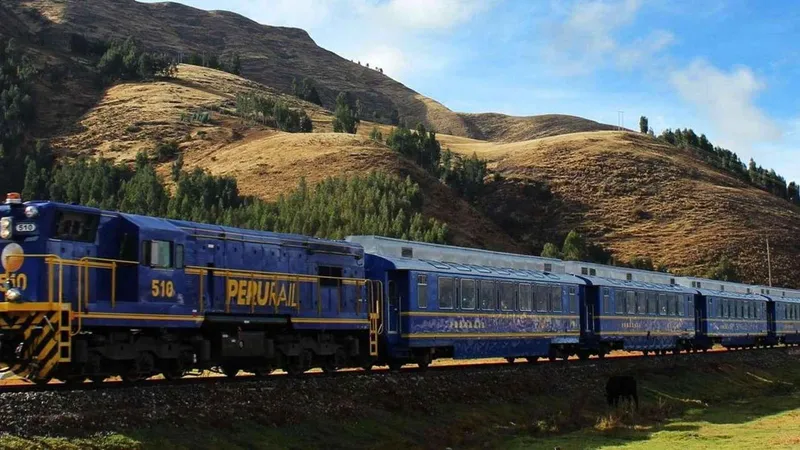 from $130.00
Train to Machu Picchu
Trip Tour books the scenic train ride from Cusco toward Aguas Calientes, the gateway to Machu Picchu, with pickup included. Cancel up to 24 hours ahead for a full refund, and note that availability is limited on this route.
Check AvailabilityPrices, ratings and details are the platform's own. Dollar figures are the listed prices. The platform bills in your account's currency.
Once You Arrive
Bus to Machu Picchu
The transfer from Machu Picchu station up to the entrance gate.
Train to Machu Picchu: Questions
How does the train to Machu Picchu work?
Two companies, PeruRail and Inca Rail, run passenger trains on the single line that ends at Machu Picchu Station in the town of Aguas Calientes, also called Machu Picchu Pueblo. Neither train reaches the ruins. From the station, a shuttle bus or the walking path covers the climb to the citadel entrance, which we compare on the bus to Machu Picchu and Aguas Calientes to Machu Picchu pages. The entrance ticket is separate and never included in the fare.
How do I buy Machu Picchu train tickets?
Both operators sell direct on their own sites, and fares vary by date and departure time, so always read quoted prices as "from" figures. Our own card, Trip Tour's train to Machu Picchu, books the 3 hours 30 minutes ride with pickup included for $130.00 and offers a full refund if cancelled at least 24 hours before start. Book the Machu Picchu entrance ticket separately, since no train ticket includes it.
Which station do I leave from for the Cusco to Machu Picchu train?
On PeruRail, from San Pedro Station, 5 minutes from downtown Cusco, with a journey of 4 hours 30 minutes, or from Poroy Station, 20 minutes from downtown, with a journey of 3 hours 30 minutes. Inca Rail sells a bimodal Cusco service, a bus to Ollantaytambo plus the train onward. SERNANP puts the Cusco to Machu Picchu Pueblo rail leg at about 111 km and about 4 hours 10 minutes overall.
Is the train from Cusco to Aguas Calientes the same as the train to Machu Picchu?
Yes. Aguas Calientes was officially renamed Machu Picchu Pueblo, and the rail stop there is called Machu Picchu Station. Every passenger train on the line terminates at that station in the town. The ruins themselves are up the hill from town, reached by the shuttle bus or on foot over roughly 6 km of switchbacks and path.
How much does the Machu Picchu train cost?
Inca Rail's live one-way fares on the Ollantaytambo route were shown from US$59 to US$85 for The Voyager, from US$81 for The 360 Degree, and from US$105 to US$133 for The Prime, all date-dependent. PeruRail does not publish a fixed public fare list in what we fetched, so we do not quote fixed PeruRail figures. Our booked card, Trip Tour's train to Machu Picchu, is $130.00 with pickup included. Remember the citadel entrance is a separate cost, and fares should always be read as "from" prices that vary by date.
See the Train Before You Book
Rider accounts covering both operators and the route into town.
Everything You Need to Know About Both Trains to Machu Picchu
A side-by-side look at PeruRail and Inca Rail before booking.
Video: Nicole Lazo TravelCusco to Aguas Calientes by Train
A first-timer's full journey from Cusco to the station in town.
Video: Leaving In 5'How to Get to Machu Picchu
PeruRail's own overview of the route to Machu Picchu station.
Video: PeruRailPrices, hours and terms are set by the venue or operator and confirmed at checkout.
We may earn a commission if you book through one of our links, at no extra cost to you. Full affiliate disclosure