 Aguas Calientes City Guide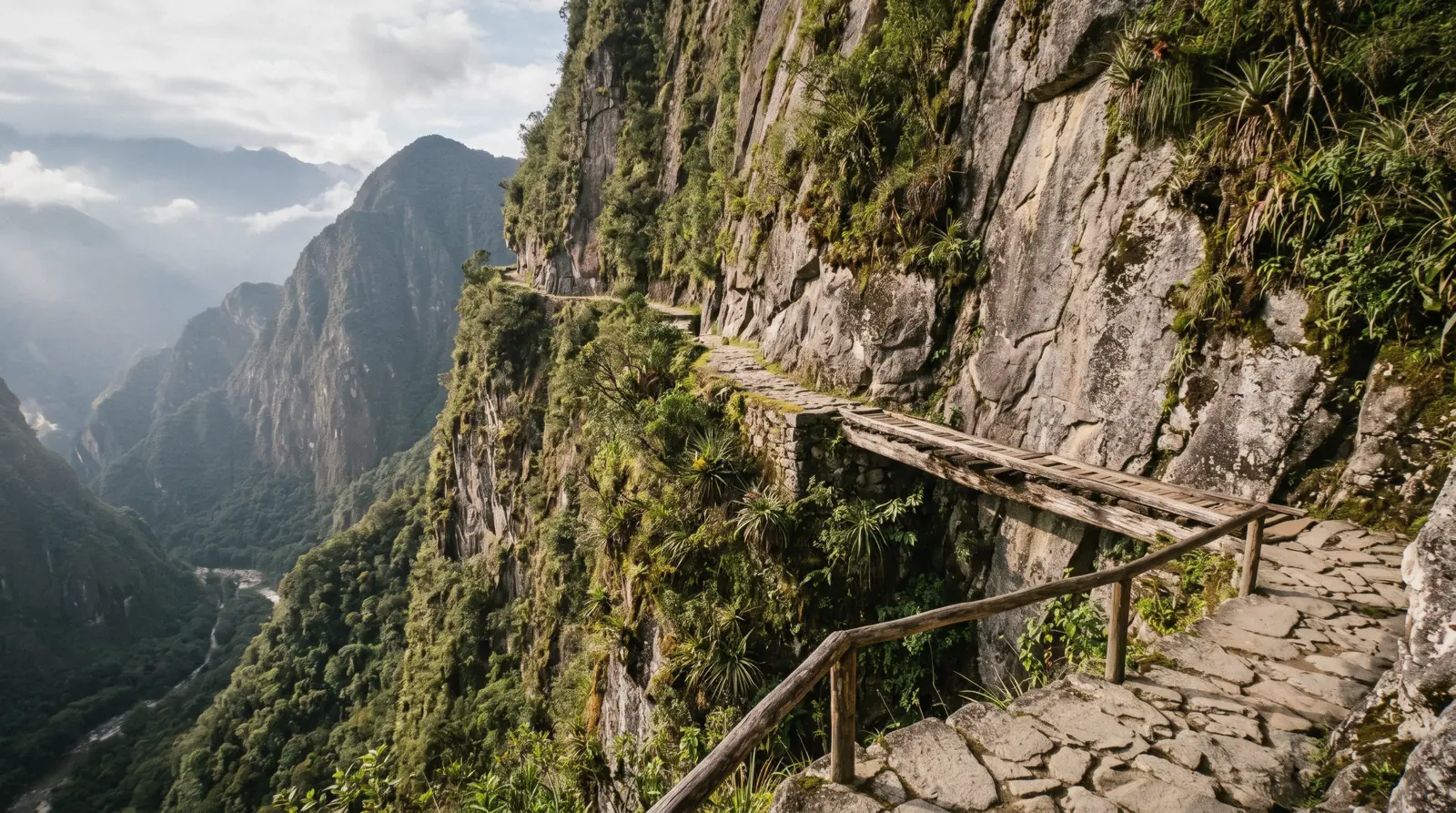
The Inca Bridge at Machu Picchu (Puente Inca)
The Inca Bridge Machu Picchu visitors reach on Route 1-D, also called Puente Inca, is a short, dramatic detour on the western edge of the citadel. It is reached on Route 1-D, a branch of Circuit 1 that the Ministry of Culture runs only in high season. The route covers roughly 2.6 km round trip and takes about an hour. At the end of the path you reach a viewing platform beside a crossing built of stone and wood, with the logs resting at the edge of a steep drop. You look at the bridge. You do not walk out over it as part of the visit, and crossing rules are not stated on any official page we can cite. This is a minor sight inside the citadel, not a separate attraction with its own gate or ticket. If you are already booking Circuit 1 in high season, Route 1-D is an easy and rewarding routing choice. This page explains what the bridge is, how the route works, and where the official record runs out. For everything else worth doing around the valley, see things to do in Aguas Calientes, and if you want a guide who knows Circuit 1, compare options on Aguas Calientes tours.
Quick answer What is the Inca Bridge and how do you visit it?
The Inca Bridge is a stone and wood crossing on the edge of Machu Picchu, reached on Route 1-D of Circuit 1 in high season only. The round trip is about 2.6 km and takes roughly 1 hour. There is no separate ticket. You choose Route 1-D when you buy your official Machu Picchu entrance ticket, priced from S/64.00 for eligible visitors under the promotional tariff.
Key takeaways
- Route 1-D is a routing choice inside Circuit 1, made at the moment you buy your Machu Picchu ticket
- The Sun Gate is the longer sibling route on Circuit 1, about 2 hours round trip against the bridge's 1 hour
- Plan the rest of your visit with our Machu Picchu guide
Key facts
Opening hours
| Llaqta visiting hours | 08:00 to 16:15. Route 1-D only in high season |
|---|
Admission
- Adult
- No stand-alone ticket. Requires a Circuit 1 Machu Picchu entrance ticket
Planning it
- Time needed
- About 1 hour round trip (official)
- Address
- Route 1-D, Circuit 1, Llaqta de Machupicchu, Machupicchu District, Cusco Region, Peru
Getting to the Inca Bridge
Both rows lead to the same path. One adds a private guide on the circuit. The other is the plain entrance ticket, with Route 1-D picked at the point of purchase or redemption.
There is no Inca Bridge ticket. Route 1-D is one of the routing options inside Circuit 1, selected when you buy or redeem the Machu Picchu entrance ticket. The table below shows two ways to arrange that.
| Option | Price | Covers | Booking | Book |
|---|---|---|---|---|
| Machu Picchu Tour Guide CIRCUIT 1, 2 or 3Visitors who want a private guide on the circuit | $42.00 | Private guide on Circuit 1, 2 or 3, pickup included, circuit assigned at booking. Entrance ticket handled separately | Book online, free cancellation up to 24 hours ahead | Check Availability |
| the Machu Picchu entrance ticketIndependent visitors who want to choose Route 1-D themselves when redeeming their ticket | $43.00 | General Circuit 1 entrance, route selected at the point of purchase or redemption | Book the card, then pick Route 1-D for your date when you claim the ticket | Check Availability |
Our card prices are per product as listed. For reference, the official promotional tariff for nationals, residents and CAN citizens on standard routes including 1-D is US$18.84 (S/64.00) per the Ministry's 2026 resolution. The foreign-adult general fee is press-reported, not confirmed on a primary Ministry document, so we do not print it as fact. Figures current in Q3 2026.
Guided Options That Cover Circuit 1
Route 1-D sits inside Circuit 1, so any guided product covering that circuit puts a guide on the same paths you will walk to reach the bridge. The closest bookable option right now is this one.
 from $42.00
Machu Picchu Tour Guide CIRCUIT 1, 2 or 3
Andean Bear guides Circuit 1, 2 or 3 depending on what is assigned at booking, with pickup included and a private group each time. Cancel up to 24 hours ahead for a full refund, and pay nothing until your booking is confirmed.
Check AvailabilityPrices, ratings and details are the platform's own. Dollar figures are the listed prices. The platform bills in your account's currency.
What the Inca Bridge Is
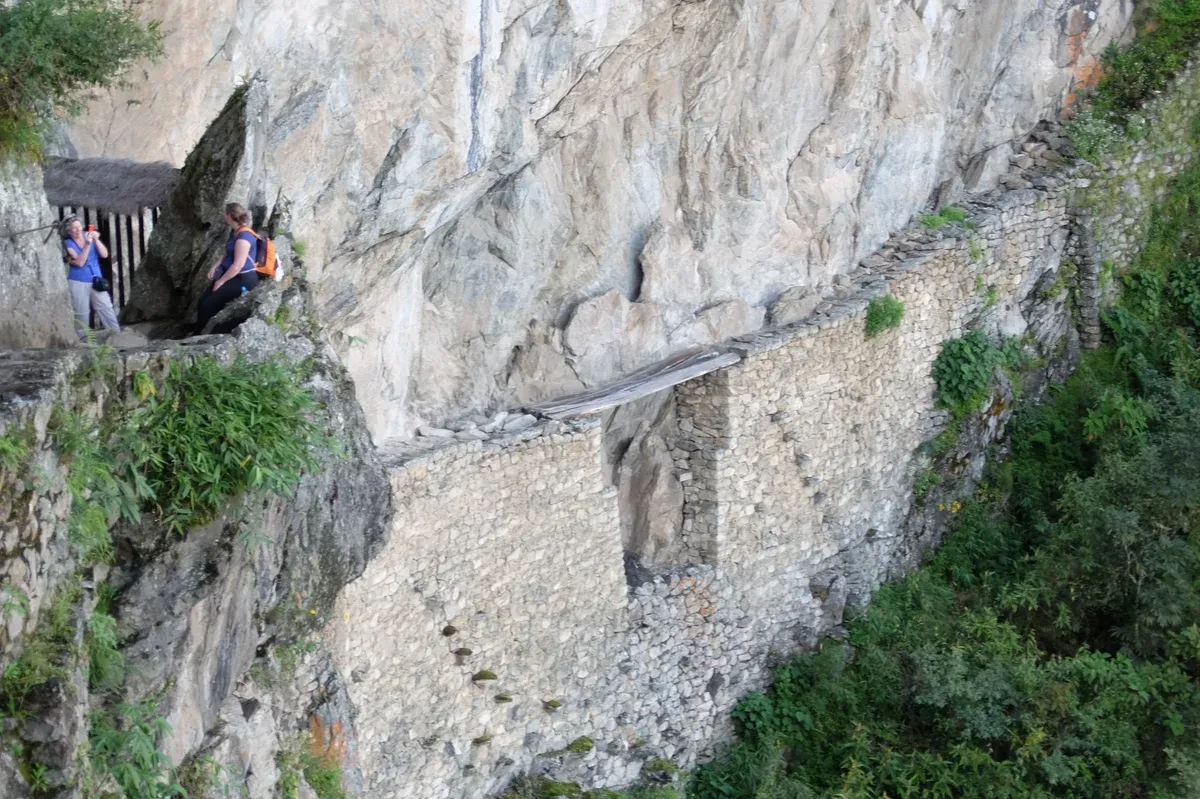
The Inca Bridge at Machu Picchu, viewed from the Route 1-D platform. Photo: Kuruman, CC BY 2.0, via Wikimedia Commons
A Crossing of Stone and Wood
The official Ministry of Culture ticketing record describes the Inca Bridge as a structure built of stone and wood, with the wooden section resting at the edge of a steep drop on the mountainside. The idea is simple and very Inca. The stone bases and the narrow path are permanent. The timber span is not. Pull the logs back and the path becomes a gap too wide to cross, which turns the entrance into a barrier. Wikidata describes the bridge plainly as one providing access to Machu Picchu, and its coordinates place it on the southwestern flank of the site, below the main terraces.
Some specific numbers you may have read elsewhere, such as the height of the drop below the bridge or the length of the logs, come from ticket-agency blogs rather than any official document. We do not repeat them here because we cannot verify them against a primary source.
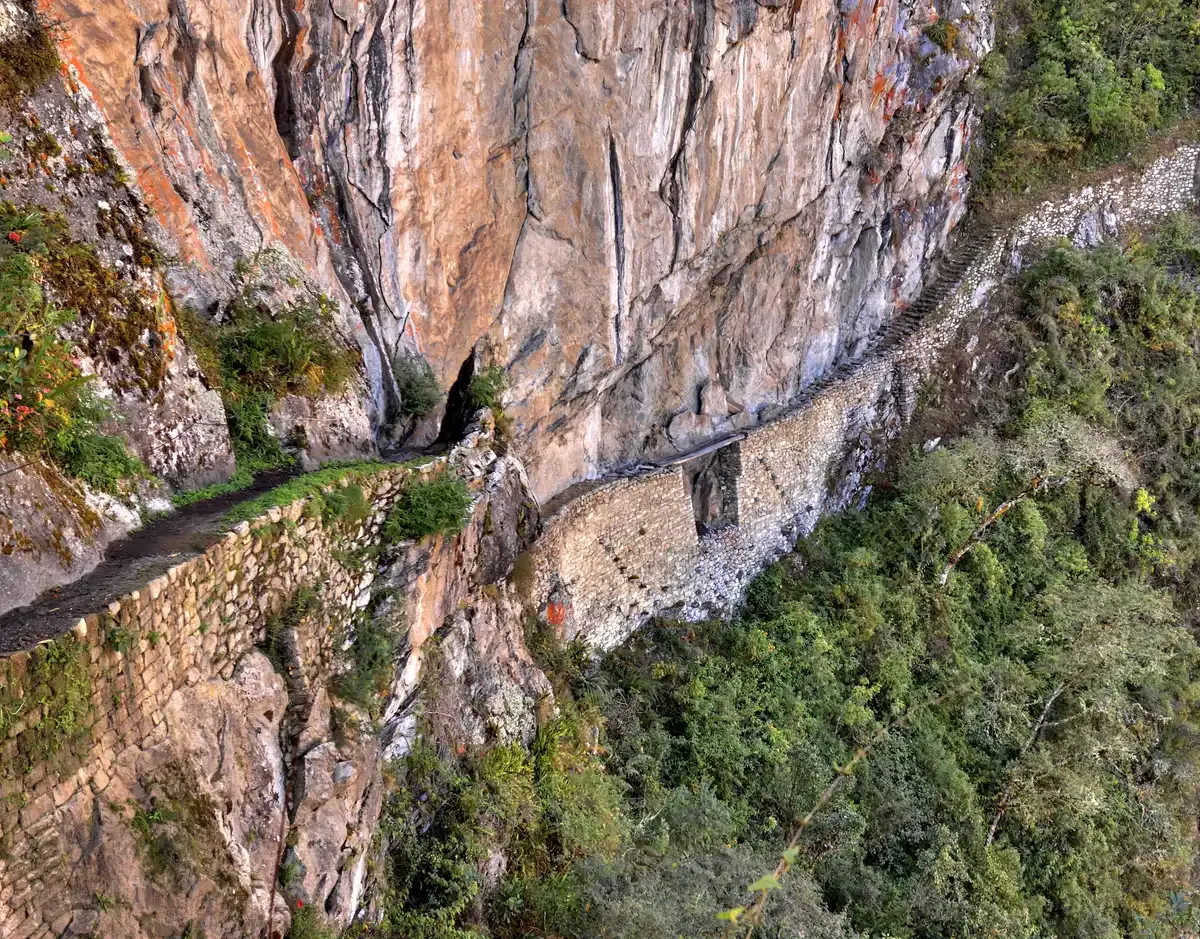
The Inca Bridge near Machu Picchu. Photo: Martin St-Amant (S23678), CC BY-SA 3.0, via Wikimedia Commons
A Defensible Entrance to the Citadel
The bridge sits on one of the paths the Incas used to control who entered and left Machu Picchu. Built across a natural gap on a steep section of the mountainside, it let people cross in normal times and let defenders cut the crossing quickly in unsafe ones. That defensive logic is not unique to this spot. Machu Picchu has several access points built around the same idea, including the Sun Gate on the ridge to the southeast, which controlled the approach from the Inca Trail.
Wikipedia's own article says the bridge may have served as a secret entrance for the Inca army, though the claim there carries no citation, so treat it as speculation rather than settled history. What is certain from the official record is narrower and more useful. The bridge is real, it is built of stone and wood, and the Ministry runs a designated route to view it.
Route 1-D and What Is Not Officially Confirmed
Walking Route 1-D
Since 1 June 2024, entry to the citadel has been organised into 3 circuits and 10 routes. Circuit 1, the Panoramico, runs along the upper terraces with wide views. Route 1-D, officially named Ruta Puente Inka, branches off it toward the bridge sector. The Ministry's own route data gives the round trip as approximately 2.6 km with a medium physical effort rating, and notes that the route offers a view over the Vilcanota valley. The trail is cut into the cliffside in places, narrow enough that the site's rules about staying on your assigned route and not using phone apps on narrow paths matter here more than on the open terraces.
Route 1-D is available only in high season. Per the Ministry's rules, the Inca Bridge alternate route takes about 1 hour round trip, which fits comfortably inside the standard 2 hour 30 minute permanence window that applies to standard routes on entries between 06:00 and 13:00. Entry slots run hourly from 06:00 to 15:00 and re-entry is not permitted, so plan your full circuit before you pass the gate.
Can You Cross the Bridge? What the Sources Do Not Say
Here is the honest answer. No official Ministry of Culture page in our sources states whether visitors may cross the bridge itself or are limited to the viewing platform. What is clear is that the visit is designed around looking at the bridge from the route's platform, with the structure and the drop beside it. Several ticket-agency sites claim crossing is prohibited for safety reasons, but those are commercial sites, not official sources, so we cannot confirm it either way and will not assert it as fact.
The same caution applies to details that circulate widely on those blogs. The height of the cliff below the bridge and the length of the timber span are not stated in any document we could verify. If the exact crossing rules matter to your visit, ask a park guard at the entrance on the day. What we can confirm is that the path to the platform is the official purpose of Route 1-D, and that the Ministry publishes its own video of the route, which we include at the bottom of this page.
Where the Inca Bridge Sits
The bridge lies on the southwestern flank of the citadel, below the upper terraces of Circuit 1. The map shows its position against the main entrance gate of the Llaqta.
Pin positions come from Wikidata and community mapping. They mark the sites, not the walking path, which follows the assigned route only.
Near the Inca Bridge
Circuit 1, 2 or 3
Route 1-D is a branch of Circuit 1. See how each circuit and route compares before you buy your ticket.
Sun Gate
Route 1-C on the same circuit, about 2 hours round trip to the Inca Trail's gateway with a classic view down to the citadel.
Machu Picchu
The citadel itself, its circuits, hours, rules and how to plan the visit around your Route 1-D slot.
Inca Bridge Questions
What is the Inca Bridge at Machu Picchu?
It is a crossing built of stone and wood on the edge of the citadel, on a path the Incas used to control access to the site. The Ministry of Culture's official record describes it as built of stone and wood and says the Route 1-D trail offers a view of the Vilcanota valley. You view it from a platform on the route.
Can you walk across the Inca Bridge?
Not officially stated. No Ministry of Culture page in our sources says whether crossing is permitted or prohibited. Several ticket-agency sites claim crossing is barred for safety, but that is not an official confirmation. The route is designed around viewing the bridge from a platform, so plan your visit around that.
How do you get to the Inca Bridge?
On Route 1-D, called Ruta Puente Inka, inside Circuit 1 of the citadel. You select that route when buying your official entrance ticket. The round trip is approximately 2.6 km with a medium effort rating and takes about 1 hour. Route 1-D runs in high season only.
Is the Inca Bridge worth seeing?
Honestly, it depends on your ticket. If you are already routing through Circuit 1 in high season, the hour is well spent and the cliffside path is one of the more atmospheric walks inside the site. On its own it is a short detour to a small structure, so it is not worth restructuring a whole visit around unless the Sun Gate or a mountain route is closed to you.
Is there a separate ticket for the Inca Bridge?
No. There is no stand-alone Inca Bridge ticket. Access comes with a Machu Picchu entrance ticket on which Route 1-D is your chosen routing inside Circuit 1. Book the Circuit 1 ticket with Route 1-D through the Machu Picchu entrance ticket, listed at US$43.00, and choose the route at booking.
When is Route 1-D open?
High season only, per the Ministry of Culture. High-season routing is set by ministerial resolution and can shift year to year, so confirm that Route 1-D appears as an option when you book on the official ticketing platform. The citadel's visiting window runs 08:00 to 16:15, with entry slots sold hourly from 06:00 to 15:00.
Official Ministry Video of Route 1-D
Prices, hours and terms are set by the venue or operator and confirmed at checkout.
We may earn a commission if you book through one of our links, at no extra cost to you. Full affiliate disclosure