 Aguas Calientes City Guide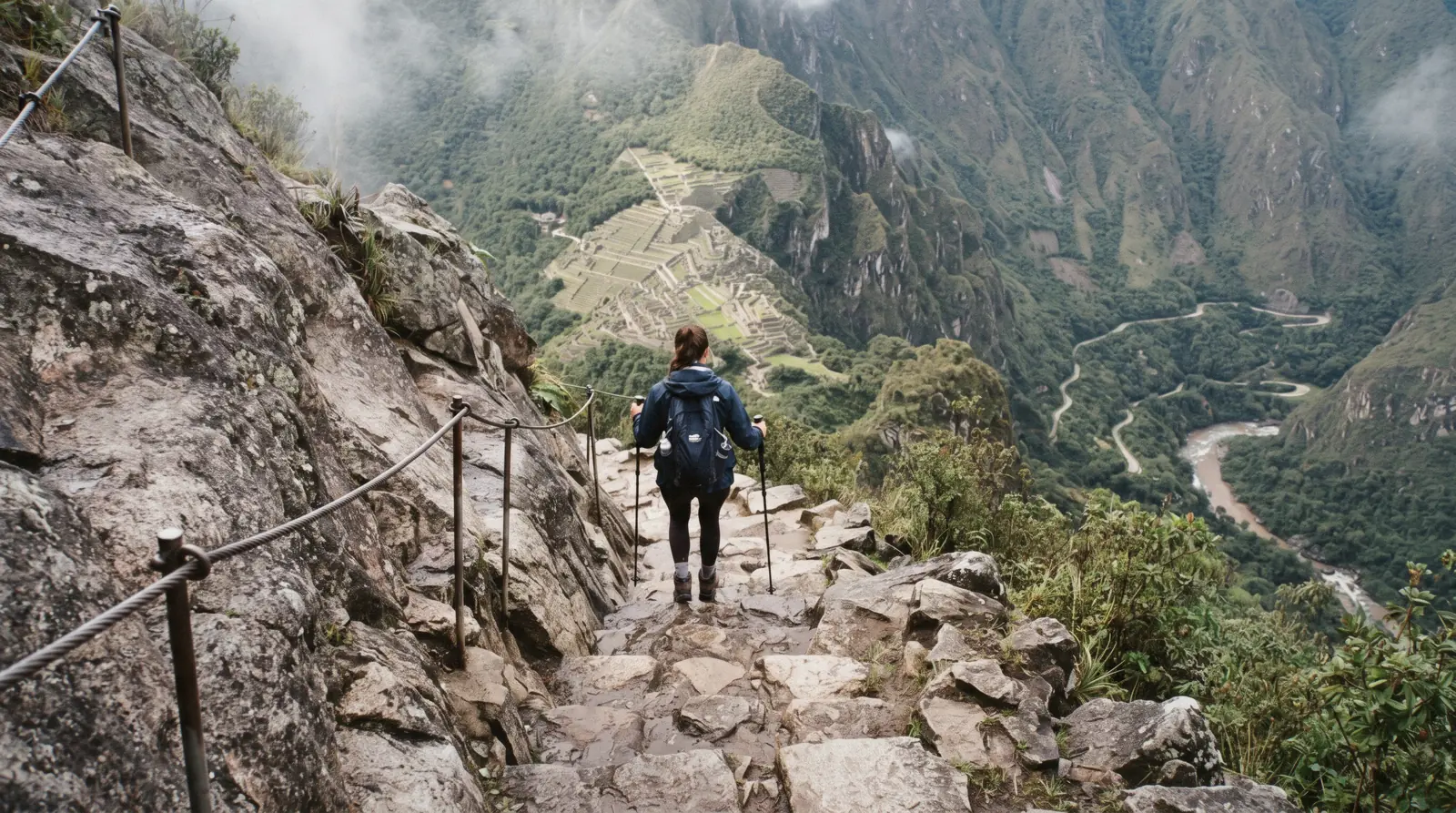
Huayna Picchu: The Climb Behind Machu Picchu
Huayna Picchu is the steep peak that rises behind the Machu Picchu citadel in almost every photograph of the site. It is climbed as Route 3-A of Circuit 3 Royalty, one of the 3 circuits and 10 routes the Ministry of Culture set up on 1 June 2024. This page covers the elevation, the climb itself, the so-called Stairs of Death, and why this site sells no stand-alone ticket for it. For the ticket rules in detail, see Huayna Picchu tickets, and for the citadel below, Machu Picchu.
Quick answer Elevation, the climb, and why there is no stand-alone ticket here
Huayna Picchu is the 2,693 m peak behind the Machu Picchu citadel (per Wikipedia), about 260 m above the ruins. You climb it on Route 3-A of Circuit 3, with entry turns at 07:00-07:30 or 10:00-10:30 and a return from the summit by 13:00. This site sells no stand-alone Huayna Picchu ticket. The one card here whose inclusions name the climb is the CuscoPeru.com full-day private tour at US$665.00, which bundles the Circuit 3 ticket with train, bus and a private guide.
Key takeaways
- The climb is Route 3-A of Circuit 3 Royalty, two entry turns per day, back from the summit by 13:00, and no tolerance at the mountain control point. See our Huayna Picchu tickets guide for how the ticket works.
- The only card on this site that includes the climb is the Machu Picchu and Huayna Picchu Full Day Private Tour at US$665.00 from CuscoPeru.com, rated 5.0 from 177 reviews, with round-trip train from Ollantaytambo and private transfers.
- Torn between the two peaks? Machu Picchu Mountain is higher (3,082 m per Wikidata) with a longer allowed climb, Huayna Picchu is steeper and closer to the ruins. Our Huayna Picchu or Machu Picchu Mountain comparison breaks it down.
- Official tickets come only from tuboleto.cultura.pe. If your date is sold out, last-minute Circuit 2 or 3 with a private guide at US$188.00 helps secure a ticket in town, and our Machu Picchu circuits explainer shows what each route covers.
Key facts
Opening hours
| Route 3-A entry turns | 07:00-07:30–or 10:00-10:30, back by 13:00 |
|---|
Closed Not closed on a schedule, but the route follows the citadel's own 08:00-16:15 visit window
Admission
- Adult
- US$33.00 (S/112.00), nationals, foreign residents and CAN citizens only
- Reduced
- US$23.50 (S/80.00), students and minors 3-17
- Free
- Not applicable, no free entry for these routes
Planning it
- Time needed
- 45 to 60 minutes on the shorter trail, about 3 hours on the longer trail to the Temple of the Moon and Great Cavern (Wikipedia)
- Book ahead
- Optional — walk-up usually fine
- Address
- Route 3-A, Circuit 3 Royalty, Llaqta de Machupicchu, Machupicchu District, Peru
This site sells no stand-alone Huayna Picchu ticket. The row below is the official seller, a fact about the rule rather than a booking link from us, plus the one card whose inclusions actually name the climb.
Are you buying the official entry, or a guide to go with a ticket you already hold?
| Option | Price | Covers | Book ahead | Book |
|---|---|---|---|---|
| The official Route 3-A ticket, tuboleto.cultura.peIndependent travellers who want the cheapest route in and are comfortable booking a fixed date and turn themselves | US$33.00 (S/112) general, US$23.50 (S/80) student/minor | Nationals, foreign residents and CAN citizens only. Foreign non-resident tariff not confirmed on a primary document | Yes, 1-5 tickets per order | Official site |
| The Machu Picchu and Huayna Picchu Full Day Private TourTravellers who want the climb, the ticket, the train and a guide handled in one private booking | US$665.00 | Circuit 3 climb, round-trip train from Ollantaytambo, private transfers and guide, 16 hours | Yes, private | Check Availability |
| Machu Picchu Tour Guide Circuit 1, 2 or 3Travellers who already hold or are booking a circuit ticket and want a guide, not a mountain guarantee | US$42.00 | Private guide for whichever circuit is assigned at booking, 2h 18m | Yes, but not a guaranteed Huayna Picchu slot | Check Availability |
| Last-Minute Circuit 2 or 3 With Private GuideTravellers who left the official booking too late and need help securing a ticket in town | US$188.00 | Helps buy the official Circuit 2 or 3 ticket, then bus and guide, 4 hours | Yes, for late bookings | Check Availability |
Figures current in Q3 2026.
Tours That Cover The Huayna Picchu Climb
One card names the climb outright. The other two are circuit guides that may or may not land on Route 3-A.
 from $665.00
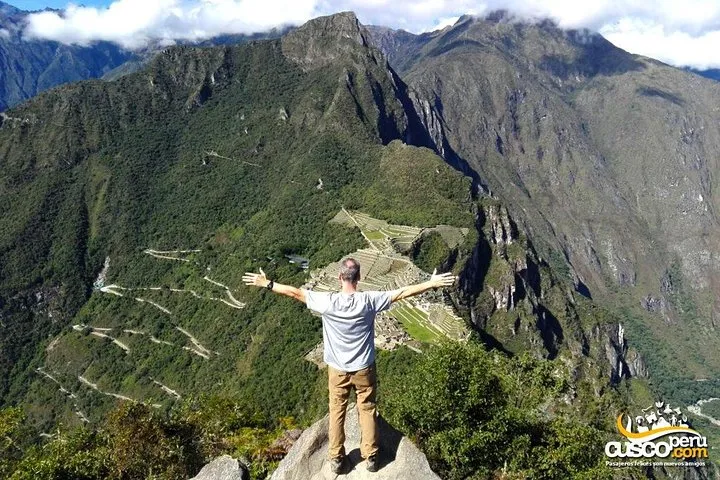
Machu Picchu and Huayna Picchu Full Day Private Tour
CuscoPeru.com adds the Huayna Picchu mountain climb, Circuit 3, to a private full-day Machu Picchu visit, with round-trip train from Ollantaytambo and private hotel-to-station transfers. All sales are final once booked, and the fitness bar is moderate given the climb.
Check Availability from $42.00
Machu Picchu Tour Guide CIRCUIT 1, 2 or 3
Andean Bear guides Circuit 1, 2 or 3 depending on what is assigned at booking, with pickup included and a private group each time. Cancel up to 24 hours ahead for a full refund, and pay nothing until your booking is confirmed.
Check Availability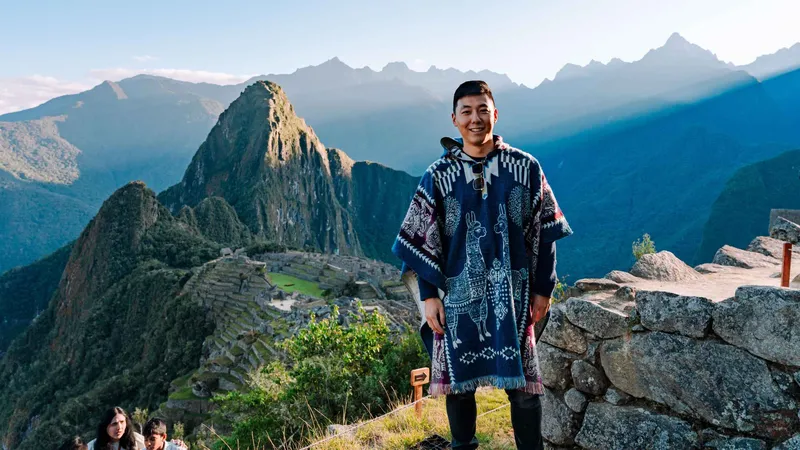 from $188.00
Machu Picchu: Last-Minute Circuit 2 or 3 with Private Guide
Peru Trekkers meets last-minute travelers in Aguas Calientes to help buy the official Circuit 2 or 3 entry ticket, then includes a round-trip bus and a private guide once it is issued. The ticket itself is non-refundable, so this suits someone who left booking Machu Picchu entry too late for the normal process.
Check AvailabilityPrices, ratings and details are the platform's own. Dollar figures are the listed prices. The platform bills in your account's currency.
How Much Time Huayna Picchu Takes
The Official Time Budget
The Ministry of Culture's rules give Route 3-A visitors two entry turns, 07:00-07:30 or 10:00-10:30. You must be back down from the summit by 13:00 either way. Total time inside the site, including the citadel itself, runs up to 5.5 hours from your entry.
That is a hard ceiling, and overstaying leads to removal from the site with park guard support. Plan your train and bus around it, because the rules leave no slack for a slow lunch afterwards.
The Two Entry Turns And What They Change
The turn you pick shapes the whole day. The 07:00-07:30 turn gets you up the mountain before the midday heat and before the site fills. It is also the only turn that can be combined with the Gran Caverna route, which pushes your total time inside to 6.5 hours.
The 10:00-10:30 turn suits travellers arriving on a morning train from Ollantaytambo, but you still face the 13:00 summit return, so the citadel portion gets squeezed. For season-by-season conditions, see our best time to visit Machu Picchu guide.
What Wikipedia Says About Trail Time
Wikipedia describes two trail options on Huayna Picchu. A shorter route takes about 45 to 60 minutes, and a longer route of about 3 hours reaches the Temple of the Moon and the Great Cavern. The article also notes the climb is harder in the rainy season, which runs November to April, than in the dry season from May to September.
Those trail times sit inside the official entry windows, but a slow pace plus queues at the narrow stair sections can eat the margin, so start at the front of your turn.
Bus And Train Context
Trains from Ollantaytambo take about 2h10m to reach Machu Picchu Pueblo (Aguas Calientes), per SERNANP's access table, and from Cusco's Poroy station the ride is 3h30m on PeruRail. From the town you still need the Consettur bus up to the entrance, or the roughly 90-minute walk per Wikipedia. If you hold a 07:00 turn, the maths get tight, which is why many climbers stay overnight in town.
Our Machu Picchu bus page covers the shuttle in detail.
Sources: Resolucion Ministerial No. 000528-2023-MC (Articulo 12), the official Horarios de Ingreso notice, and Wikipedia trail times, checked 2026-09-25
The Climb, The Stairs, And What Wikipedia Says
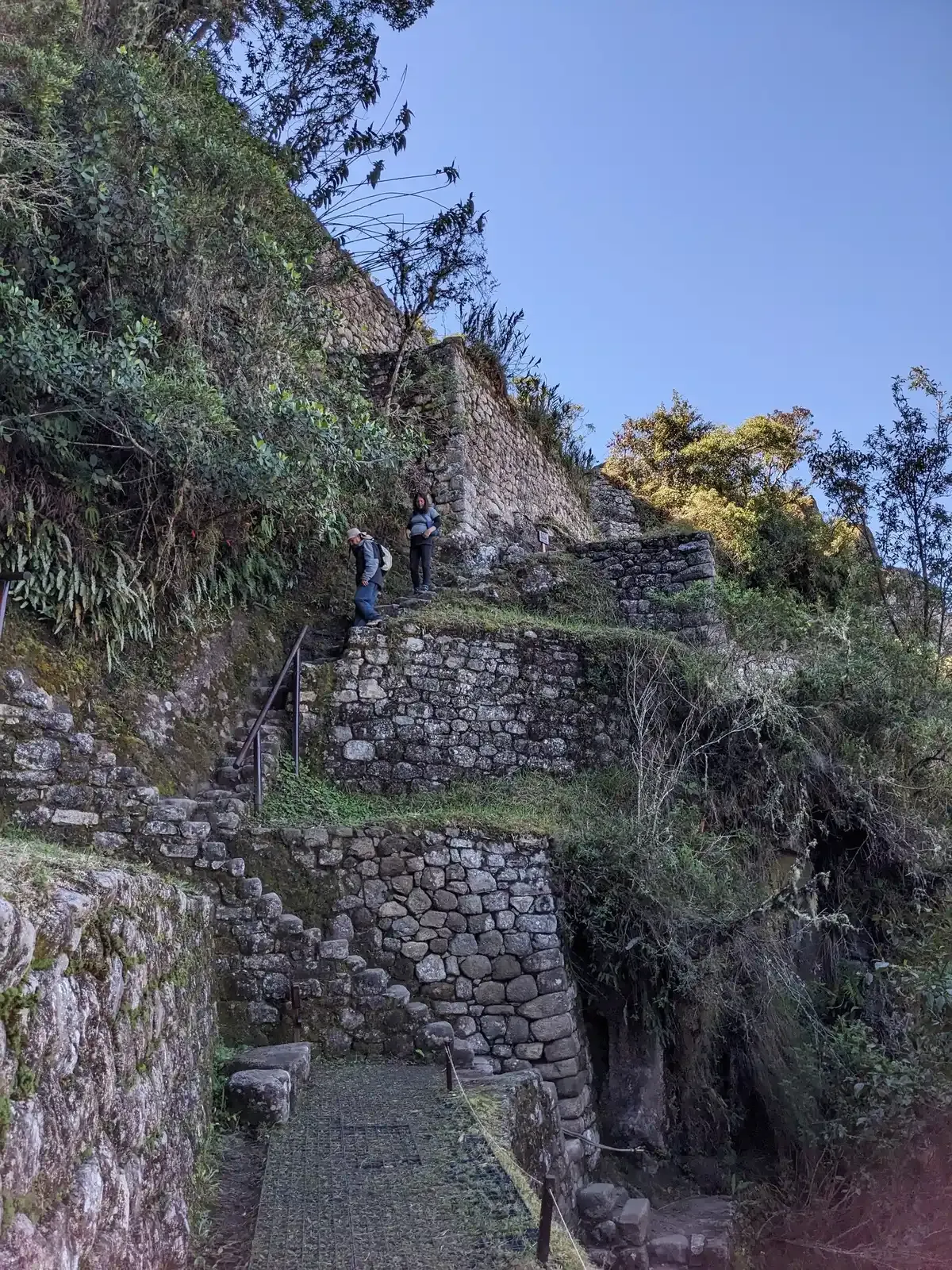
Steps on the upper section of the Huayna Picchu trail, close to the summit. Photo: Crookesmoor, CC BY-SA 4.0, via Wikimedia Commons
How Difficult Is It Really
Wikipedia calls the path steep and, at times, exposed. That is the honest summary. You are gaining about 260 metres from the citadel gate to a 2,693 m summit (all elevation figures per Wikipedia), on Inca stone steps that in places are cut directly into the rock face.
Sections use a fixed steel cable as a handhold. It is a short climb, 45 to 60 minutes up on the shorter route, but it is sustained and it demands sure footing. The operator behind the full-day private tour states a moderate fitness bar for exactly this reason.
If you are comfortable on steep, uneven terrain without rails, you will manage.
The So-Called Stairs Of Death
You will see the phrase Stairs of Death on tour pages and travel blogs. It is an informal nickname used by tour operators and travel writers, not an official Ministry of Culture or SERNANP designation, and no primary source names the stairs that way. What the source record actually supports is this: steep, narrow stone stairs on the ascent, in places cut directly into the rock, with sections using a fixed steel cable as a handhold.
Wikipedia's own wording is that the path is steep and at times exposed. No step count or specific dimension is published in any official record, so treat any precise figure you read elsewhere with suspicion.
Rainy Season Versus Dry Season
Wikipedia notes the climb is more difficult in the rainy season, November to April, than in the dry season from May to September. Wet stone steps and exposed ledges do not mix well, and the mountain path offers fewer escape points than the circuits below. In the dry months the rock is grippier and mornings are cooler.
Whenever you go, wear proper shoes, because hard soles and heels are banned inside the site anyway. Check our things to do page for what else pairs well with a mountain morning.
Is Huayna Picchu Worth It
If you want the classic postcard shot of the citadel with the peak behind it, this is the route that delivers it, because no other circuit reaches this vantage. The Incas built the trail themselves, per Wikipedia, and the temples and terraces at the top are part of the reward, not just the view. The trade-offs are real: a non-refundable, name-locked ticket, a fixed entry turn, a 13:00 summit deadline, and a steep path that is not for anyone uneasy with heights.
If that list reads as a fair price to you, it is worth it. Our dedicated Huayna Picchu tickets guide helps you decide on the ticket itself.
Huayna Picchu Or Machu Picchu Mountain
Both peaks sit in the same S/112 promotional tariff band for nationals, residents and CAN citizens, so the price gap is zero in that band. The difference is character. Huayna Picchu (2,693 m, per Wikipedia) is steeper and shorter, with the famous exposure.
Machu Picchu Mountain (3,082 m per Wikidata Q45776914) allows up to 4 hours of climbing with a return from its summit also by 13:00, and total time inside up to 6.5 hours. In brief: pick Huayna Picchu for drama and speed, Machu Picchu Mountain for a longer, higher walk with fewer squeeze points. The full argument lives in our Huayna Picchu or Machu Picchu Mountain comparison.
Source: https://en.wikipedia.org/wiki/Huayna_Picchu, checked 2026-09-25
Temple Of The Moon And The Great Cavern
What The Incas Built On The Peak
Per Wikipedia, the Incas built a trail up the side of Huayna Picchu and constructed temples and terraces at its top. Local tradition holds that the summit served as the residence of the high priest. That gives the climb a purpose beyond the view: you are walking a genuine Inca route to a genuinely built-over summit, not just a scramble to a lookout.
The structures are modest compared to the citadel below, but the setting makes them some of the most strikingly placed architecture in the whole sanctuary.
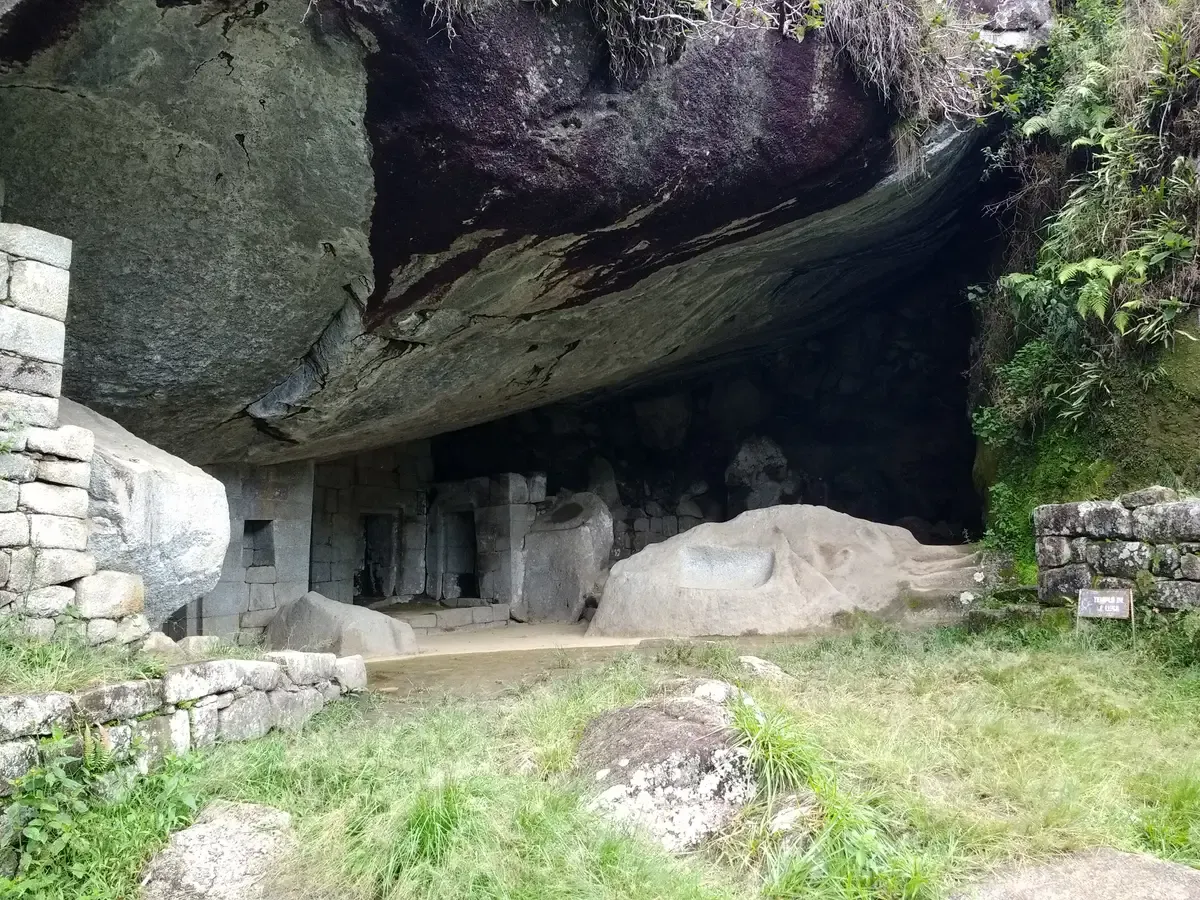
Templo de la Luna, on the long trail below the Huayna Picchu summit. Photo: Mx._Granger, CC0, via Wikimedia Commons
The Temple Of The Moon
The Temple of the Moon sits on the longer route, reached on the roughly 3-hour trail Wikipedia describes rather than the 45-to-60-minute direct path. Wikipedia records that the temple contains several caves lined with finely crafted stone blocks. It is a quieter, enclosed space, quite different in feel from the open summit.
On its own it anchors Route 3-C, the Gran Caverna route, which runs in high season only when not combined with the mountain climb. See our Machu Picchu circuits page for where 3-C fits in the system.
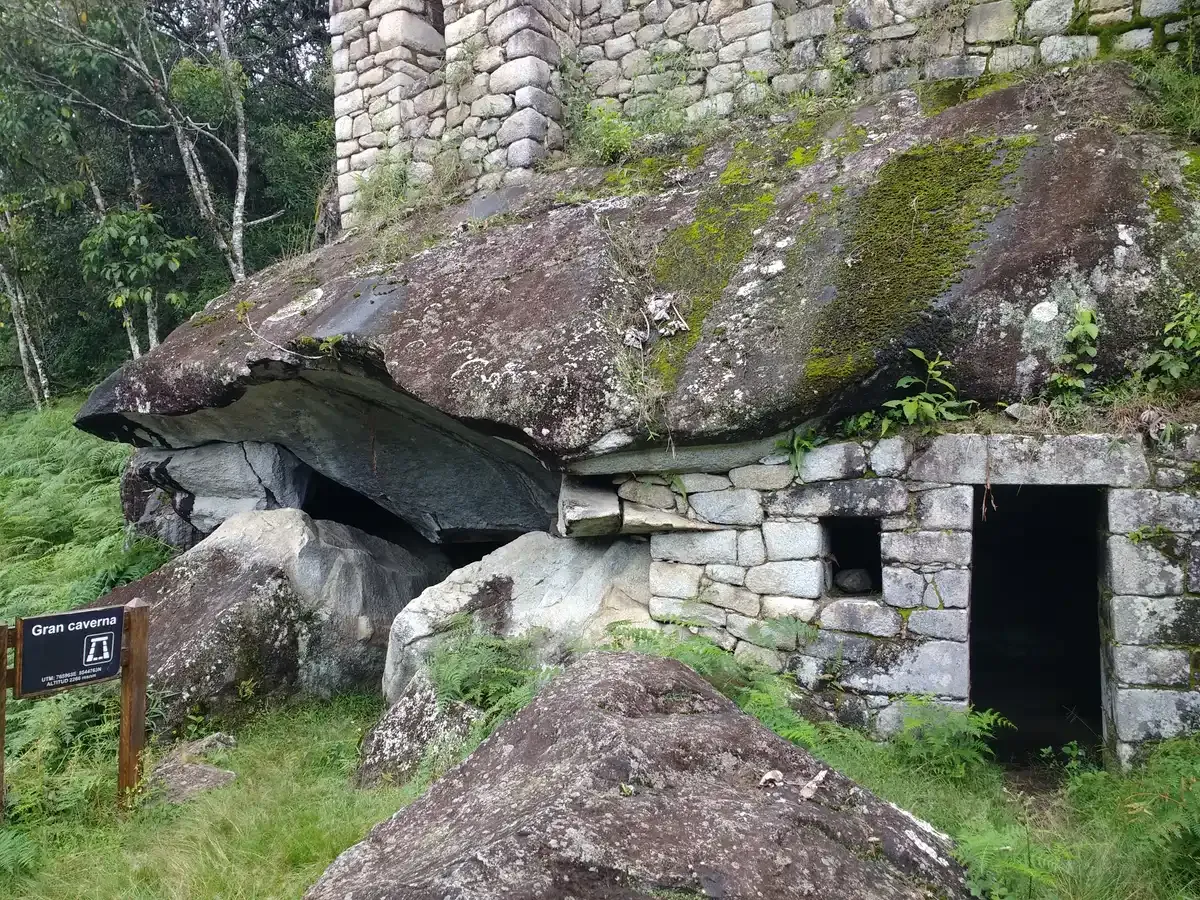
Gran Caverna, near the Temple of the Moon on Huayna Picchu. Photo: Mx._Granger, CC0, via Wikimedia Commons
The Great Cavern
The Great Cavern's walls include false doorways and trapezoidal niches with double and triple jambs, details Wikipedia describes as ornamental rather than residential in character. In plain terms, the masonry is decorative and symbolic, not the footprint of everyday living. It pairs with the Temple of the Moon on the long trail, and reaching it means committing to the 3-hour option rather than the quick summit dash.
Stone lovers will find the double and triple jambs among the finest work on the mountain.
The Combination Rule
You can only combine the Huayna Picchu summit with the Gran Caverna on the FIRST entry turn, 07:00-07:30. Combined visitors must be back down by 11:30, and total time inside, citadel included, extends to 6.5 hours from entry. If you take the 10:00-10:30 turn, it is the summit route alone, with the standard 5.5-hour ceiling and the 13:00 summit return.
Route 3-C on its own, without the mountain, is a separate high-season-only route under the circuit system introduced on 1 June 2024.
Source: https://en.wikipedia.org/wiki/Huayna_Picchu and Resolucion Ministerial No. 000528-2023-MC (Articulo 12), checked 2026-09-25
Why There Is No Stand-Alone Huayna Picchu Ticket Here
How The Ticket Actually Works
Huayna Picchu is not sold as its own ticket anywhere. It is Route 3-A of Circuit 3 Royalty, one of 3 circuits and 10 routes created by R.M. No. 000528-2023-MC, in force since 1 June 2024. You buy a Circuit 3, Route 3-A entry with a fixed date and one of two turns, 07:00-07:30 or 10:00-10:30.
The ticket is name-locked and date-locked, non-refundable outside force majeure, and your passport is checked at the gate.
Where To Buy
Official online sales run only through tuboleto.cultura.pe, the Ministry of Culture's own platform. That is the official source for every Route 3-A ticket. There is no booking flow on this page for the entry itself, and we do not resell Ministry tickets.
What we do sell is guided and bundled products layered on top of a valid circuit ticket, and our Machu Picchu tickets explainer walks through the official purchase process step by step.
The One Bundle That Names Huayna Picchu
If you want the climb handled for you, the Machu Picchu and Huayna Picchu Full Day Private Tour from CuscoPeru.com is the only card on this site whose inclusions name Huayna Picchu. It costs US$665.00, runs 16 hours, holds a 5.0 rating from 177 reviews, and adds the Circuit 3 climb to a private full-day visit with round-trip train from Ollantaytambo and private hotel-to-station transfers. All sales are final once booked, and the operator states a moderate fitness bar.
It is a premium price for zero logistics on your side.
Guide Cards, Honestly Explained
Two other cards work with Circuit 3, but neither guarantees the mountain route. The Machu Picchu Tour Guide Circuit 1, 2 or 3 from Andean Bear costs US$42.00, runs about 2h18m and holds a 4.8 rating from 71 reviews. You get a private guide for whichever circuit is assigned at booking, and Circuit 3 assignments can mean the designed route 3-B or the mountain, so do not book it expecting the summit. The Last-Minute Circuit 2 or 3 With Private Guide from Peru Trekkers costs US$188.00, runs 4 hours, and holds a 5.0 rating from 9 reviews. It helps a late planner buy the official ticket in town, then includes a round-trip bus and a private guide.
Again, the ticket is non-refundable and the route within Circuit 3 is not a Huayna Picchu guarantee.
What The Official Prices Are
For Peruvian nationals, foreign residents and CAN citizens, the 2026 promotional tariff for Route 3-A is S/112.00 general (US$33.00) or US$23.50 (S/80.00) for students and minors, per R.M. No. 000284-2025-MC. No primary document located for this page states the foreign non-resident tariff, so we print no figure for it. On daily numbers, Wikipedia cites a historic cap of about 400 climbers a day in two groups of 200, but that is Wikipedia's own figure from the older ticketing system and is not re-confirmed in the current resolution text, and no primary Ministry resolution in this pack states a Huayna Picchu-only daily cap.
What is confirmed is the overall Llaqta capacity of 4,500 visitors a day, rising to 5,600 in high season.
Sources: Resolucion Ministerial No. 000528-2023-MC, Resolucion Ministerial No. 000284-2025-MC, tuboleto.cultura.pe, checked 2026-09-25
Rules Specific To The Mountain Control
No Tolerance At The Mountain Gate
Standard Llaqta entries allow 30 to 45 minutes of arrival tolerance depending on season. The mountain control points do not. The Huayna Picchu checkpoint must be entered at your exact ticketed time, per the official horarios notice.
Miss your turn and there is no late window that saves you, and the ticket is non-refundable. Arrive at the citadel entrance early enough to walk to the mountain control before your turn opens.
The 13:00 Summit Deadline
Route 3-A visitors must return from the summit by 13:00, whichever turn they hold. Control points on the path enforce movement, and overstaying the overall 5.5-hour window results in removal with police or park-guard support under the site rules. Build your descent time into the plan rather than treating 13:00 as a target.
The citadel's own last entry slot is 15:00 and the whole site closes at 17:30, so there is no evening catch-up either.
Banned Items That Bite On This Route
The site-wide ban list applies on the mountain path too, and several items matter more up there. Bags over 40x35x20 cm are prohibited, so bring a small pack. Food is banned, as are tripods, selfie sticks and walking sticks, which removes aids many hikers expect.
Drones are prohibited, hard-soled shoes and heels are banned, and smoking or vaping is prohibited throughout. Violations mean immediate expulsion without refund, and on a narrow exposed staircase there is nowhere to argue your case. Our Machu Picchu rules page lists the full ban.
Identification At The Gate
You must carry your entry ticket plus official ID at all times inside the site. Foreign visitors use a passport, carne de extranjeria or diplomatic ID. The reduced promotional tariff requires proof of status, such as a DNI for Peruvians or a SUNEDU-validated student card for the student rate.
Because the ticket is name-locked, a mismatch between ticket and passport can end your climb at the control point, so check the spelling when you buy.
Source: Resolucion Ministerial No. 000528-2023-MC (Articulo 12, 17), machupicchu.gob.pe Normas de Conducta, checked 2026-09-25
Five Things Most Visitors Do Not Know About Huayna Picchu
- The peak rises to 2,693 m (8,835 ft), about 260 m above the citadel, and the Incas built both the trail and the summit temples themselves [Wikipedia]. - Local tradition says the summit was the residence of the high priest, which is why the peak carries built structures at all [Wikipedia]. - Combining the summit with the Great Cavern and Temple of the Moon is only possible on the first 07:00-07:30 turn, with a return to the bottom by 11:30 [R.M. No. 000528-2023-MC, Articulo 12]. - The famous Stairs of Death nickname is informal, used by tour operators, and is not a Ministry of Culture or SERNANP designation [not an official source, stated as such]. - Wikipedia's oft-quoted 400-visitors-per-day cap comes from the older ticketing system and is not restated in the current resolution, so treat it as a historic figure [Wikipedia, unconfirmed against R.M. 000528-2023-MC].
Huayna Picchu, The Day In Dated Steps
The Route 3-A day in official steps, from booking to the summit deadline.
-
Before travel
Buy the Route 3-A ticket
Purchase on tuboleto.cultura.pe for a fixed date and turn, 07:00-07:30 or 10:00-10:30. The ticket is name-locked, date-locked and non-refundable. Our tickets explainer covers the process.
-
Entry turn
Pass the mountain control on time
Arrive at the checkpoint inside your exact turn, there is no tolerance here. Passport and ticket in hand.
-
First hour
Climb to the summit
Wikipedia puts the shorter route at about 45 to 60 minutes, steep and at times exposed, with cable handholds on the steepest sections.
-
By 13:00
Be back down from the summit
The return deadline applies to both turns, and the overall window on Route 3-A is 5.5 hours from entry.
-
Optional, first turn only
Add the Gran Caverna
Combine with Route 3-C on the 07:00-07:30 turn only, back down by 11:30, total time inside up to 6.5 hours.
Sources: R.M. No. 000528-2023-MC (Articulo 12) and the official Horarios de Ingreso notice, trail times per Wikipedia.
Huayna Picchu, Do And Do Not
Short list on booking, timing and what the mountain control actually enforces.
Do
- Book your Route 3-A turn on tuboleto.cultura.pe well ahead, since the ticket is date-locked and name-locked.
- Take the 07:00-07:30 turn if you want the option of adding the Gran Caverna and Temple of the Moon.
- Wear grippy shoes with soft soles, since hard soles and heels are banned and the rock gets slick in rain.
- Start at the front of your entry turn to keep margin before the 13:00 summit return.
- Carry your passport with the ticket at all times, including at the mountain control point.
- Consider the full-day private tour if you want train, bus, ticket and guide handled in one booking.
Don't
- Do not bring a bag larger than 40x35x20 cm, food, tripods, selfie sticks, walking sticks or drones.
- Do not count on late arrival, because the mountain control has zero tolerance while the citadel gates allow 30 to 45 minutes.
- Do not treat the Stairs of Death label as an official warning, it is a tour-operator nickname for a steep, exposed path.
- Do not book a Circuit 3 guide card expecting a guaranteed summit slot, since Circuit 3 also runs the designed route 3-B.
- Do not plan the citadel leisurely first, because your total time inside is capped at 5.5 hours on Route 3-A.
Huayna Picchu On The Map
Huayna Picchu On Video
Huayna Picchu: The Thrilling Hike Above Machu Picchu
A walkthrough of the ascent and the stairs described on this page.
Video: YouTubeMachu Picchu - Very Steep Stairs, Climbing Down Huaynapicchu
A close look at the descent on the steepest stair sections.
Video: YouTubeMachu Picchu Mountain
The taller, higher peak on the other side of the citadel, Route 1-A of Circuit 1, with its own entry turns and ticket rules.
Huchuy Picchu
The small neighbouring route inside Circuit 3, high season only, at a lower elevation.
Machu Picchu Circuits
How all 3 circuits and 10 routes fit together, and where Route 3-A sits in the system.
How difficult is it to climb Huayna Picchu?
Wikipedia describes the path as steep and, at times, exposed. You gain about 260 metres to the 2,693 m summit in roughly 45 to 60 minutes on the shorter route, on stone steps partly cut into rock with a steel cable handhold in places. It is harder in the rainy season, November to April, than from May to September. The operator of the full-day private tour sets a moderate fitness bar, which is a fair signal of the demand.
What are the stairs of death on Huayna Picchu?
The name is an informal nickname used by tour operators and travel writers for the steep, narrow stone stairs on the ascent. It is not a Ministry of Culture or SERNANP designation, and no official source uses it. What is documented is a steep, exposed path with sections cut into the rock and a fixed steel cable as a handhold. No official step count or dimension exists, so be wary of precise numbers elsewhere. Our rules page covers what is actually enforced.
Which is better to hike, Machu Picchu Mountain or Huayna Picchu?
Huayna Picchu (2,693 m, per Wikipedia) is the steeper, shorter climb with the famous exposed sections and the classic view down onto the citadel. Machu Picchu Mountain (3,082 m per Wikidata) allows up to 4 hours of climbing and more total time inside, 6.5 hours versus 5.5. Both share the same promotional tariff band for nationals and CAN citizens. The detailed trade-offs are in our Huayna Picchu or Machu Picchu Mountain comparison.
Is Huayna Picchu worth visiting?
Yes, if you want the best elevated view of the citadel and do not mind a steep, exposed path on a fixed schedule. You walk a genuine Inca trail past temples and terraces built at the summit, per Wikipedia, and the 45-to-60-minute effort rewards you with a perspective no other route offers. The costs are a non-refundable ticket, a hard 13:00 summit return and a real fitness demand. Compare options in our Huayna Picchu tickets guide before committing.
Can I buy a Huayna Picchu ticket from this site?
No. We sell no stand-alone Huayna Picchu entry, and none exists anyway, since the climb is Route 3-A within a Circuit 3 ticket sold officially on tuboleto.cultura.pe. What this site offers are guided products: the full-day private tour at US$665.00 is the only card whose inclusions name the climb, while the circuit guide and last-minute ticket helper work with Circuit 3 without guaranteeing the mountain route. Our tours page lists everything available.
Prices, hours and terms are set by the venue or operator and confirmed at checkout.
We may earn a commission if you book through one of our links, at no extra cost to you. Full affiliate disclosure